Friday, June 27, 2008

NAC - Reflections

Now that the North American Convention is over and I am on my way home I have to time to reflect on the last week.

Overall, it was a positive experience. The opportunities for spiritual challenge and to connect with friends overshadowed the seemingly countless number of meetings that are part of my annual trek to Anderson. As I talked with others, it is apparent that virtually everyone else shared similar sentiments: The 2008 NAC is considered to have been a success.

Upon reflection, however, I wonder if perhaps the whole event has become too comfortable. It is a good experience, but hardly one that elicits much passion. The people who attend, many of them diehard fans who return regularly, come because it is an affirming environment. But, the overall trend of declining attendance suggests that for the vast majority of movement adherents this "campmeeting" is not a priority worth the expense and time commitment. The event has lost its drawing power, except for those who make it as an annual pilgrimage.

It is easy to delude ourselves into believing that this is the core, common experience of our movement. That may have been the case in the distant past when this "doctrinal practice" (as Strege would label it) was the primary means to define and unite our movement. In pure numbers and in proportion to our overall constituency fewer people are coming to the North American Convention. We fool ourselves to think that the high level of effort expended for it are in line with its real significance. Certainly, Church of God Ministries probably devotes more attention and activity to the NAC than anything else, but this may be misguided.

At one time in the Church of God, virtually everyone made it their goal to attend "Anderson Campmeeting" as often as possible. It was the "can't miss it" event of the year. But, this is no longer the case for the overwhelming majority. I was particulary aware of this reality when observing the General Assembly attendance and that an extremely small number of influential leaders and pastors were in attendance. The few that were made brief appearances and were hard to track down. Most did not take in the entire convention.

Am I down on the NAC?

Not at all. I happen to believe that corporate gatherings are one important aspect of our common identity and fellowship. But, I remain convinced that as our world has changed, so has our movement. An annual convention in Anderson as it is currently formatted is no longer relevant.

I am sure that the success of Sunday's global service will make it more difficult for many to see my case. The effective leveraging of technology is a positive step forward and has the potential to draw more people together across the Church of God. It was the highlight of this year's event. But, let's not be fooled, over the long run this still does not really address the need for drawing in the growing number of diverse congregations across North America and around the world.

I remain convinced that the proposal I outlined last year is still the best, realistic option available to us. We need more than cosmetic changes of the NAC. I doubt, however, that there is enough political will in the Midwest to relinquish the sacredness of our current format.

I will continue, however, to be a voice from the geographic fringes calling for fresh, new approaches to propel our movement into the future.

Wednesday, June 25, 2008

NAC - Wednesday

It's hard to believe the final day of the North American Convention has come and gone!

Today began with the final session of the General Assembly. As usual attendance was lower, and it made me wonder how legitimate the GA's authority is considering the extremely low participation. There was no earth-shattering business, although a new baseline budgeting process was approved. (For more details see twitter.com/chogblog)

Tonight was the final service, focused on missions. In the past this was the climax of the week, with attendance overflowing. Wednesday evening no longer has the same lustre - attendance was among the lowest of all week in my assessment.

Paul Sheppard preached and delivered a fitting send-off message, although he seemed far from the assigned text. UPDATED 06/30/08: Curt Ferrell sang another poignant song that I am assuming he wrote (Possible title: "Get Up and March"?). People were captivating by the words and the rhythm. (Curt: Please confirm the details for us!)


This service has traditionally ended with a "pass it on" candlelight ceremony. Since moving into the Kardatzke Wellness Center they moved from candles to chemical light sticks (not quite the same effect!) and the whole exercise was getting quite predictable. This year we all lit our sticks together after long colored ribbons were run through the auditorium and lifted after the benediction creating a joyous spectacle.


And after saying our final goodbyes we headed outside to experience the increasing humidity. Fortunately, the hot, humid weather is just about to kick-in here in Anderson and we will avoid it! Overall, weatherwise, this was one of the most pleasant conventions that I can remember.

Tomorrow I will write some final comments and reflections on this year's NAC.

Tuesday, June 24, 2008

NAC - Tuesday

Tuesday at the North American Convention marks the start of General Assembly.

My blow by blow account of the GA can be seen at my twitter log (twitter.com/chogblog). Probably the biggest "news" today concerned the budgetary struggle that Church of God Ministries is facing. Giving is down and for 2008 there will be a 10% spending reduction. But this is more than a one-time occurrence. It is part of an ongoing downward trend and obviously this could have severe long-term implications projected forward. Apart from this, the GA was positive. Although, in some ways it felt like we were all just going through the motions - our annual ritual.

Of course, the most touching moment of GA is the annual memorial service. This year saw almost 80 individuals recognized, including some very well known ones of our movement such as Gerald Marvel, Horace Sheppard, Gilbert Stafford, and Oral Withrow.


It was fitting that Rod Stafford (Gil's brother) was tonight's preacher. Sharing the pain he experienced over the past year, he gave a forward-looking message that included an audio segment from Gilbert's last sermon. This led to a conclusion centered around an annointing service, something led at the NAC last year by Gil. We all left experiencing grace and hope.


Monday, June 23, 2008

NAC - Monday

For me, the highlights of today centered around two conferences held in Byrum Hall.

First, was the annual Doctrinal Dialogue sponsored by the School of Theology. I believe that these types of experiences are extremely valuable, and we need many more of these forums for exchange and discussion. This year's theme was on the biblical view of creation, and featured a paper presented by Dr. James Christoph of Warner Southern College. (Papers can be downloaded from the SOT website). The content was very good, but perhaps too sketchy because of the time available and I found participants all danced around the issue to some extent knowing the controversial nature of the subject matter and the emotional responses it generates.

Immediately following there was an open forum with Ronald Duncan and his recent paper on congregationalism. Obviously, with my recent blog coverage I was especially keen to see what kind of reaction he would receive. I was particularly impressed with Dr. Duncan's genuine interest to generate dialogue, and his passion for the church. Despite what some may say, this is no top-down pronouncement. There were good questions and comments from the audience, with almost everyone affirming his observations and concerns. My only disappointments were that the attendance wasn't great (less than 70), and the people who disagree with his paper didn't seem to be present or at least engaging the issues.


Today's speaker was Cynthia James, Area Administrator in Northern California. She brought an amazing combination of thoughtfulness and energy to her message based on Ephesians 4:11.


This year from Monday to Wednesday the same person preaches both services. There is some confusion among convention goers as to whether these are the same sermons, but at different times and worship experiences. Apparently this is not the case (even though they are preaching from the same text), but for the future this needs to be clarified.

A look at the gathering area in front of the Kardatzke Wellness Center:


All we need are some rides!

General Assembly to be Twittered

Those of you familiar with this relatively new communication technology will be interested to learn that I will be twittering live from this year's General Assembly which will start on Tuesday morning.

Twittering is text messaging on steriods, and allows for the wide distribution of short messages to friends and other interested persons. Messages can be read in your web browser, on your cell phone, through an RSS feed, or on the sidebar of this blog's main page.

The new CHOGblog twitter can be accessed at:
http://twitter.com/chogblog

If you are unable to attend this year's GA you will be able to take advantage of live updates throughout the sessions on Tuesday and Wednesday. If you are attending the GA you might still want to subscribe to the twitter to hear my comments and to feedback some of your own.

Admittedly this is an experiment. I doubt many will take advantage of it this year, but it will be a way to try out a new technology (and will keep me awake during those long, dry spots in the GA!).

Sunday, June 22, 2008

NAC - Sunday

2008 will be remembered as a significant year in the history of "Anderson Campmeeting". Tonight's service marked an attempt to bring the North American Convention to the larger church since fewer people are actually making the trek to Anderson.

Through the use of technology tonight's service was broadcast live to over 200 churches in a number of countries around the world who watched this service and participated in simultaneous communion. Actually, live broadcasting of the services is not new, with streaming live video having been available for several years now. This service was a milestone because it was a deliberate effort to have people congregate in various locations to watch and express unity through the Lord's Supper. It was called the largest gathering in the history of the Church of God.

The experience exceeded my expectations. It was obviously well planned by the CBH team, taking into consideration the unique needs of audiences at distant locations watching on video screens. This was not a normal service with worship followed by preaching. Hosted by Jim Lyon and Robbie Davis it was a diverse celebration that also featured some live worship from Crossings Community Church in Oklahoma City, and several other live and taped greetings from other CBH locations globally.

The communion experience itself was unique as the platform participants sat around tables and took the elements after sharing Scripture read in several different languages.

Without question this will become a regular event of the NAC and its new tradition and highlight.


I have never seen so many communion sets in one place:

Saturday, June 21, 2008

NAC - Saturday

Even though Saturday is the official first full day of the North American Convention, it is still a low-keyed time compared to when things start picking up Sunday when even more people arrive.

For me, today was spent primarily in meetings pertaining to Area Administrators. This included a session with writer Milfred Minatrea, author of the book Shaped by God's Heart: The Passion and Practices of Missional Churches.

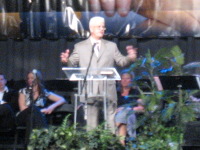
Despite last night's Anderson University sponsored celebration, Saturday evening marks the true keynote service of the convention. Without introduction the service began with Church of God historian Merle Strege setting the tone with some reflections on our movement's struggle to put unity into practice. Curt Ferrell is this year's evening worship leader and as part of his contribution shared again his powerful song, "One Body, One Spirit, One Lord". This was a signficant climax that followed and made up for what seemed to be first night jitters and technical glitches.

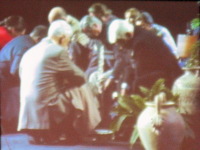
General Director Ron Duncan was our speaker tonight and focused on love as the key to unity, asking us to consider "What kind of church do you have?" The significance of Duncan's message went beyond words. Following his sermon he led in a public demonstration of the unity needed in God's church. Three denominational leaders plus GA chair Bob Moss (representing other church communions) were seated on stage while Duncan, and leaders from the National Assocation, the Hispanic Concilio, and Native American Council washed the feet of these four men. It was a significant act that leaves a strong impression on us as we ponder the implications of unity within a largely fractured Body of Christ.


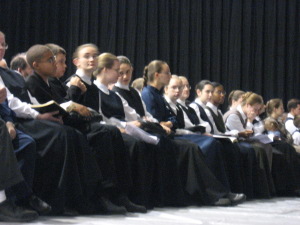
Fitting to tonight's theme, it was interesting to see in attendance a contingent of individuals from one of the conservative splinters of our movement:


Friday, June 20, 2008

NAC - Friday

For me, Friday at the North American Convention, was an opportunity to connect with a number of friends and associates including my Area Administrator SHAPE cluster.

The convention itself kicked off this evening with the annual Anderson University service, a gathering of celebration centered mainly around music. This Gaither production was jam-packed with singing, musical performances (including by NFL player / singer Ben Utecht), and brief personal stories from Ann Smith, Mort Crim, Dr. Lauren Dungy-Poythress, and Bill Gaither). The highlight was a powerful AU choral rendition of "I Then Shall Live", a song with profound lyrics by Gloria Gaither set to the tune of Finlandia. This year's convention theme is "Celebrate Unity", and tonight's service celebrated God's Gentle Strength.


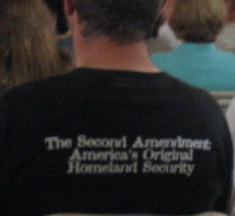
In striking contrast to tonight's biblical theme was a T-shirt message spotted in the crowd:

I must be in the Midwest!

Thursday, June 19, 2008

History of the NAC

As thousands head to the center of our universe this week, I would encourage the reading of an article published in the Anderson Herald Bulletin newspaper and available on the Church of God website. The article gives a very brief, but informative overview of the development of our annual gathering, from camp meetings to the North American Convention it is now.

Wednesday, June 18, 2008

Off to the NAC

You will probably notice that I have been somewhat quiet here on CHOGBlog for the last month. As I previously indicated, I have been extraordinarily busy as a whole host of responsibilities, challenges, and deadlines have converged on me. There are some topics I want to address here (including some further thoughts on congregationalism), but have had to set that aside for the moment in order to retain balance and sanity.

Tomorrow I am off to the North American Convention of the Church of God in Anderson, Indiana, which begins this weekend. While for me the NAC is packed full of meetings and obligations, I am looking forward to allowing this also to be a time of refreshment and spiritual nourishment. As I have done in the past, I will be blogging daily on my experiences.

I am also pleased to announce the First-ever CHOGBlog Get Together at the NAC:

Sunday evening
9:30pm
at Starbucks
(4235 Scatterfield Road, Anderson)


If you can be there, I would love to meet you!

Friday, May 16, 2008

Connecting through CHOGnews

Life has been extremely busy lately, so I haven't delivered yet on my concluding posts on congregationalism.

But, in the meantime...

Church of God Ministries has recently launched CHOGnews a monthly e-mail newsletter devoted to "News and Information about the Church of God". This is obviously in response to the demise of ONEvoice last year, and the desire for more communication to keep us connected. There is also a print version available as a PDF download for churches to copy and distribute to those without e-mail.

In our electronic age this is a long-overdue step, and certainly will fill a much-needed gap. It's not the only communication we need, but it is a welcome initiative.

You can subscribe HERE.

Friday, May 09, 2008

Blogger: Wayne Warner

Before I continue on my comments on congregationalism I want to highlight another Church of God blog worth noting. Wayne Warner, a retired Church of God minister who has done extensive writing. His new blog, "Warner's World", is a new avenue for him to share his provocative thoughts and ideas. I bring this up now because, in light of my recent discussion, I encourage you to read his post on "Church of God and Mutual Accountability".

Thursday, May 08, 2008

Congregationalism - The struggle with individualism

In the next two posts I want to declare and elaborate on some of my thoughts concerning the recent discussion on congregationalism.

Interestingly, some of the opposition to Dr. Duncan's paper I've heard is based on the assertion that autonomy is not a bad thing and is a safeguard from the hierarchical, denominationalism that we have traditionally resisted.

While I have trouble finding this counter-argument promoted in Scripture, I easily understand why many have bought into it outright or have been strongly influenced by it. We live in a society that has elevated the individual to the highest position. "I" am the most important entity, and everything is viewed through this ego-centric filter. As a result, congregations are also seen as autonomous and independent.

Sadly, this heightened individualism and independence has been adopted by much of Western Christianity. Spiritual narcissism places the emphasis on "Jesus and me", with community values downplayed or almost ignored. Worldly values have crowded out biblical ones. It is no wonder autonomy is so highly regarded.

Certainly, our faith is personal, but it should never be private. Scripture consistently paints a picture of individuals as part of God's larger collective people: Israel, Kingdom of God, Church, Body of Christ, etc. While we encounter God as individuals, we live out our faith through our participation with and through God's People. As individuals our lives are to be interwoven with those of others: "each member belongs to all the others" (Romans 12:5b NIV).

The Church of God emphases on holiness and unity express an essential balance between the life of the individual and God's vision for the church. I believe, however, that we have had trouble fully developing our ecclesiology in practical ways. We were good at deconstructing the church as it was in the late 19th century, but poor at translating our ideals into tangible forms. Our abhorrence to organization prevented intentional developments, and instead resulted in haphazard creations that often lacked effectiveness. And it is not only with our national and regional structures that we have struggled to find ourselves, but even at the congregational level itself. It is important to remember that at the beginning of the Reformation Movement there was virtually no form to local congregations. Local church structures themselves were perceived as part of the problem, and this coupled with our eschatology and enthusiasm negated the formal establishment of congregations. Over time, however, the need for congregational structures became apparent and were developed, although as a reaction to necessity instead of proactive design for mission.

If we are going to grapple with the issue of congregationalism we must honestly address the underlying assumptions that have shaped our beliefs and practices. Then we can begin to find healthy expressions for church life. More on that in my next post...

Wednesday, April 30, 2008

Congregationalism paper - responses

I am somewhat surprised with the dialog that has been going on in response to Dr. Duncan's paper concerning congregationalism. I will write my personal comments on all of this in a subsequent post, but for now I want to share the buzz that I have been hearing on the matter.

Since posting the notification of the paper a few weeks ago, I have been involved in a number of conversations with people. You can read for yourself the various comments that were posted on this blog, but as you probably know only a very small percentage of readers ever take the time to actually post a comment. Some have e-mailed me privately, and I have been involved in several verbal discussions as well.

Overall, most people I've had contact with agree with Dr. Duncan's general premises. But, the stumbling block that I hear most people facing are the potential practical implications of all of this. There is a recognition that something must be done to overcome rugged congregational individualism, but naturally, considering our heritage, virtually no one wants to create a denominational monster complete with top-down hierarchy and rigid structures of accountability.

There are, however, other views as well. Certainly I have heard a couple of rare individuals who have expressed that maybe we need to become less congregational and adopt a more presbyterian (small "p") polity.

And, there are those who think Dr. Duncan is leading us down the wrong path. Some, it appears to me, are just plain suspicious of anything that comes out of Anderson, believing that this is an attempt to center more control in our national offices. Others, believe that there is nothing wrong at all with our congregationalism, and therefore this discussion is a waste of time.

Of course, there is large apathetic group that are so preoccupied with their own stuff that they don't care or see any value in the matter. Nevertheless, based on what I am hearing so far, this is an issue that touches a nerve for many people.

I think it is extremely healthy that we engage in this dialogue and confront head on some of the assumptions, both right and wrong, that have shaped our beliefs and practice.

More to come.

Monday, April 21, 2008

Doctrinal Leaders

In light of Gilbert Stafford's recent death, I was intrigued with an insightful post at Seminary Blog regarding "Doctrinal Leaders" in the Church of God.

Check it out.

Thursday, April 17, 2008

Congregationalism paper

Several months ago I posted on the draft edition of a paper that General Director Ronald Duncan wrote concerning congregationalism. In case you have not already received a copy of the final edition, you can download it from the Church of God Ministries website.

I'd be interested in your comments.

Friday, April 11, 2008

Labeling

One of the most tragic results of a divided universal church is the increased tendency toward using labels as a way to perpetuate disunity. And, I am not just talking about denominational labels.

A sign of our times, particularly in the polarized political climate of the United States, is the large chasms that are created by using the labels "conservative" and "liberal" in political, social and religious settings. As a movement which has resisted dividing the church based on human categories, we too have easily succumb to this form of divisiveness.

Labels themselves are not evil. They are useful to describe things. The danger comes, however, when we use labels as a simplistic way to set ourselves over and above others, and to attack people who differ with us by resorting to pejorative attacks based on nomenclature. It is too easy for a liberal to put down a conservative, or a conservative to attack a liberal. It's a great way to shut someone up, instead of really getting to know them and their ideas.

Few even understand these designations. Many assumptions and prejudices are formed in people's minds surrounding these labels, and most are not grounded on any real understanding of the issues.

It should be no surprise to most reading this that the Church of God predominately tends toward conservatism. There are very few real liberals among us. But, of course, for staunch conservatives anyone who does not agree with their worldview must be a liberal. The fact is that most of the schisms and splits that have occurred in our movement are the product of conservative factions that have emerged.

Interestingly, Scripture promotes neither a conservative nor a liberal agenda, at least by current standards. These are human perspectives that are imposed upon the message of Jesus. What people fail to see is that liberals and conservatives are simply flip sides of the same coin. That is, they are actually more similar than they are different, simply because they share the same modern philosophical roots. While they appear to have different worldviews, looking beneath the surface it becomes clear that both liberals and conservatives are products of the Enlightenment, bowing at the altar of reason to the point of extinguishing the flame of the Spirit.

I consider myself as neither liberal or conservative. But, as a follower of Jesus I recognize that I have many brothers and sisters in Christ who might fit into either the conservative or liberal camps. Our goal should be to rise above the rhetoric and find our center and ground in Christ, and to avoid being taken in by those who promote a lordship outside of Jesus, such as conservatism or liberalism.

For us in the Church of God it is especially important that we put our unity teachings into practice and avoid labels that fracture the Body of Christ. Do we really extend our fellowship to "every blood washed one"?

As traditional denominational loyalty disintegrates in our society, perhaps ideological labeling is the new denominationalism that is dividing the church.

How committed are we to our message to do something about this?

Monday, March 31, 2008

Remembering Gilbert Stafford

I was saddened to learn of the death of Dr. Gilbert Stafford yesterday (March 30th).

This is a significant loss for the Church of God. Dr. Stafford has been our most noteworthy theologian in recent years. But, despite his sharp mind, prominent seminary teaching, and significant written contributions, he was not merely an academician. Stafford was truly a pastoral scholar. From his own extensive pastoral experience he understood firsthand that theology was not merely an abstract exercise, but very practical. He also expressed this through his love and passion for the church and this movement.

Frequently I hear people asking where the Church of God theologians are. This week one of them is with our Lord.

Friday, March 21, 2008

Basics for ... Living - II

My recent post, Basics for ... Living, generated some valuable responses to my suggestion that we need more thoughtful discussion (i.e. books, etc.) on what holiness really should look like in today's world. Generally, commenters recognized the need, but suggested that we are either too afraid to really get into this discussion or too prone to narrow, rigid positions.

I raised this question because I remain convinced that at the core of our Church of God identity is the emphasis on the practical outworking of faith. Yes, we do struggle with defining the implications of holiness today, and as result have tip-toed around the subject. I would be the last person to suggest that there is, or even should be, a Church of God "standard" for all aspects of behavior. Legalism is not consistent with the message of Jesus. But, our failure to help people wholly integrate their faith into their daily lives renders our teaching on holiness inert.

One person suggested "starting a praxis discussion here". While I hope interaction of this nature will take place far beyond this blog, this can be a good starting point for some of us. Watch for opportunities in the coming weeks.

He is risen!

Thursday, March 13, 2008

Basics for ... Living

I received a postcard advertisement in the mail today from Warner Press promoting the second edition of their Basics for Belief book that will be published this year. It is a book designed to answer the question, "What do Church of God people believe?", especially because "newcomers want to know how our beliefs compare to those of other Christians".

I haven't seen this book, but I'm sure it is a fine writing. It appears to be an updated, edited compilation of some previous doctrinal writings by noteworthy Church of God leaders.

My question, however, is: Why is Warner Press not publishing books pertaining to HOW we should be living as followers of Christ? For a praxis movement emphasizing holiness would it not be important for us to present teachings on what holiness looks like in today's world?

It's much easier to churn out doctrinal writings than thoughtful, engaging discussions on the implications of our doctrines.

Monday, March 03, 2008

Blogging is good for your social life

On a lighter note...

According to a post at TechCrunch, "a new study has found Bloggers are better adjusted and live healthier, happier social lives."

And, some of you thought I was crazy!

Friday, February 29, 2008

What draws us together? - II

Last week I had the privilege to spend some valuable time with one of our African American ministers. It was a good discussion on a number of levels, but one matter in particular caught my attention, especially in light of a my previous post, "What draws us together?", and the discussion that followed.

We talked about how our four African American congregations could be better drawn into the overall fellowship of our district. The reality, however, is that it is not only a black-white issue. The Pacific Northwest Association is probably the most diverse regional district within the Church of God, and I'm not just talking about race. Beyond the diversity represented in African American, Hispanic, and Native American churches, we also have a very wide spectrum of congregations in terms of ministry philosophy and, dare I say, even theological perspective. Much of this can be attributed to the unique challenges we face living in the most unchurched and highly secularized area of the country.

The tentative solution we explored in our talk is that our unity is likely not going to be achieved merely by trying to get everyone to participate in common events and programs. While such corporate practices are ways that we can tangibly experience our togetherness, the reality is that even when we come together it is almost impossible to find fully meaningful expressions that truly take into account the diverse cultures across our expansive region, which covers portions of three states. Some bemoan the fact that there is less of a Church of God "style" in language, worship, etc. than in past generations, but this is a reality of the diverse nature of the Body of Christ at large, of which we are committed to uphold over our "denominational" provincialisms.

We must be reminded that our unity is first and foremost in Christ. But, we must even be reminded what that means. This unity in Christ is not just a sterile assent to certain doctrinal beliefs concerning Christ. It is recognizing that as a result of the sacrificial life of Jesus we are also to take up the cross and follow him. That is, through the church to join his Kingdom effort within the world.

In other words, mission is the primary way that we are to express our unity. More often than not we have been distracted by other attempts at uniformity and conformity merely through doctrine and corporate practices, and have failed to demonstrate the most important way that we can rally together under the lordship of Christ.

Tuesday, February 19, 2008

NAC changes

I recently received a packet of materials from Church of God Ministries pertaining to this summer's North American Convention.

Two things in particular stood out to me:

1. This year's preaching schedule from Monday through Wednesday appears to have the same speaker and sermon each day. In other words, two identical? services each day but at different times. This is a radical departure from the previous format, but in truth the morning services have not been well attended in recent years. I'd be interested to hear the rationale for this change, but it is evident that they are experimenting with changes because of new realities.

2. I was very disappointed to see that this year there is no guest speaker from outside our movement. This has been a personal highlight for me in recent years (e.g. Reggie McNeal and Jim Wallis) and is important for us to have input from the outside.

As I've indicated before, we need to rethink the role of the NAC and be willing to think outside the box. The changes proposed this year are hardly steps in that direction.

Friday, February 08, 2008

What draws us together?

The matter of autonomy versus accountability is a significant discussion topic right now in the Church of God. This was evidenced in my recent post, "Congregationalism", and in the comments that followed. And, I hear this discussion coming up in many other settings as well.

As a movement we struggle because we are wanting to affirm our identity, but are frustrated because we have been largely stagnate, as one commenter noted.

Some are concerned that the move toward greater structural accountability is a move away from our core beliefs and values, and that we will become another denomination. I understand the concern, but I think it misses the point, and is a hyper-spiritualized smokescreen that avoids our sinful independence.

All of this seems to beg some more foundational questions that we must ultimately address: What is it about the Church of God that is unique? What is it that should unite us and draw us together?

The answers cannot be fully explored in this one post (and may require several, and even a book!), but some basic observations can be made.

For the most part, and in real terms, we have found our commonality in our doctrines and practices. Gilbert Stafford, in his two Crossroads books, asserted this and bemoaned the dilution of these two elements within our movement. Certainly, when we grasp for ways to define ourselves we tend to end up at our doctrinal distinctives (i.e. holiness, unity, healing, amillenialism, etc.) and corporate practices (i.e. campmeetings, music, publications, institutions, etc.). I believe, however, that Stafford's solution is far too shallow and misses the dynamic that was at the genesis of the Church of God. Yes, our doctrines and practices are markers of who we are and have importance. But, I would contend that they are themselves inadequate foundations for making us the movement we believe God wants us to become.

I believe the answer we are seeking for can be found looking back to the beginning of our movement.

The energy that drove the earliest pioneers was a sense of mission. They were enthusiastically convinced that God was using them to draw His church together in holiness, and they were prepared to radically deliver that message everywhere and using virtually any available means. They allowed themselves to be directed by the Spirit in amazing ways.

As with any reformation movement, the brazen energy of our founders began to fade after the first decade or so. Some self-doubt set in, and the saints themselves settled into more routine and structure. Soon the mission itself was gradually replaced with talking about the mission and glorying in past accomplishments. Doctrine and practices became our rallying points. We also bought into the rational Christianity of Evangelicalism, and were largely constrained by Midwestern Christian culture.

If we are to recapture our place as a movement it must be around a clear mission of what it is we believe God has called us to do. This mission must be more than a stated ideal, but a commitment to Christ that expresses itself in practical action. As I see it, our sense of and involvement in mission is the element that will revitalize the Church of God. Fortunately, there are signs here and there of that already beginning to happen.

What exactly, then, is our mission today?

Tuesday, January 22, 2008

To dance or not to dance?

The Church of God proudly promotes holy living, and for the bulk of our history we have had generally accepted guidelines of what that looks like. Yet, the list of sinful behaviors has changed over the years, and has included obvious vices like smoking and alcohol, and less obvious ones like wearing neckties and even visiting bowling alleys. Dancing is also an activity that has been traditionally scorned, but over time has seen less opposition by movement adherents.

Early this month a major turning point occurred at our flagship institution of higher learning, Anderson University. After years of pressure and coming to terms with its inconsistent policies, AU held its first on-campus dance, a move officially endorsed by the school's board of trustees. Has dancing now joined the list of other practices once shunned, but now accepted, or at minimum tolerated?

The Anderson Herald-Bulletin newspaper has an article detailing this development.

The truth is, despite that a significant contingent of Church of God people think dancing is one of the great sins that leads to all sorts of debauchery, this is no longer the general view held by our membership. While there are forms and presentations of dancing that raise concern, most people recognize that a blanket rejection of it as an activity or art form is not reasonable, and certainly not biblical. We even have congregations across the country who occasionally have dances or offer dancing lessons.

Obviously, the news out of AU is highly disturbing for those Church of God stalwarts who cling to a view of holiness that is all about externalism.

For me the shift in our dancing policies and practices is not the real issue, and not just because I have two left feet and can't dance even if I wanted. The issue is: How are we understanding and practicing what it means to be holy?

Sadly, a thoroughgoing engagement with holiness is not something we do, despite our assertions. Throughout our history we have missed the boat when we have reduced holiness to rigid adherence to individualistic legalism. This misapplication of Scripture flies in the face of the
Spirit-directed life which should mark our lives. The result has been self-righteousness, judgmentalism, and the extinguishing of the Spirit's work. And, hypocrisy abounds especially as it has resulted in a lop-sided holiness that virtually ignores other expressions of a holy life, including our social involvements.

The reaction to this wooden holiness has also not been always helpful. As the Herald-Bulletin article reveals, some of the responses to our restrictions can be reactionary. It is easy for the pendulum to swing too far or for the wrong reasons.

What am I saying in all of this?

I believe that the Church of God must be committed to re-engage in an exploration of what holiness is all about. In doing this we must be prepared to move beyond our constricted views from the past and toward a much fuller understanding as demonstrated by Jesus and expressed in Scripture. This will be one of the topics of my upcoming book.

In the end we may acknowledge that we are a dancing people after all.

Wednesday, January 16, 2008

Congregationalism

Last week I was in Saint Augustine, Florida for the annual Area Administrator's retreat. It was a good time to connect with colleagues from across the continent and to exchange ideas and experiences.

General Director Ronald Duncan was with us for the week, and shared a paper he wrote entitled "Congregationalism and the Church of God Reformation Movement: A Needed Conversation". It was still a draft edition, but the intent is to have a final version ready for distribution in the not too distant future.

Certainly this is a needed conversation. As Duncan says, our "understanding of congregationalism has functioned largely as an unquestioned assumption in the life of the church", and that many have seen it "as synonymous with independence or unlimited autonomy".

In the paper Duncan traces the development of congregational polity from Scripture through to its implementation in our movement. He argues that things started to unravel for us around the late 60s or early 70s. Rampant individualism in society, carried over into the local church and into the Church of God at a larger level. "Unlimited autonomy within an increasingly loosely connected congregational system" has become the accepted norm, but Duncan correctly points out that this is "totally alien to a biblical understanding of the body of Christ". Nevertheless, the result of all this is disconnection, isolation, and loss of trust. He even goes on to call this "an insidious cancer in the life of the church".

The remedy, according to Duncan, is covenantal relationships, both within and among congregations. Responsibility of all involved is critical, and leads to interdependence that is centered on mission. This should radically shape the way we function as a movement.

I affirm what Dr. Duncan is writing. If we are going to have any impact as a movement we must address what it means to belong to "Church of God" and the implications of this belonging. Sadly, the Church of God has sold itself out to the prevailing attitudes of society and Evangelicalism, even when it deeply conflicts with what we understand as truth. Even more tragically, we have failed to acknowledge these influences.

Hopefully Duncan's paper will lead us to confront these issues. Be sure to read it when it is officially released.

Monday, December 31, 2007

Reflections on 2007

It's that time of year when one reflects back on the past year and looks ahead to the one coming.

2007 was a very busy year for me personally. Settling in to my new position in the Pacific Northwest has been very demanded. This coupled with my new book project hasn't left much time for blogging. Yet, there has been considerable activity across the Church of God that is worth commenting on.

I am firmly convinced that we are positioned at a critical point in the history of our movement. There are certainly unique circumstances affecting us, but we are also highly influenced by the larger shifts that are occurring in the religious climate across North America. Someday we may very well look back to the first decade of this millennium as a major turning point for the Church of God. Either we will forge ahead in fresh ways with our collective calling, or we will continue sliding into oblivion.

Based on what I have observed in 2007, I am hopeful. While there remain large bastions of immobilized thinking and behavior across the Church of God, there are encouraging signs of renewal. Many of these indicators are subjective and intangible, but it is evident to me that a much more enduring transformation is taking place that is impacting our spirits and attitudes. Beginning with the Strategic Planning Council in August 2006, these shifts have been noticeable. This past year these observable trends continued, and were most evident at the recent Coaches Training event in Tampa, Florida. Specifically, we are seeing a renewed emphasis on spiritual direction and leadership. There is increased dialog on our very being as a movement, there is a greater realization of our need to be missional, and there is vibrant, new generation of pastors and leaders emerging.

I, for one, will be working to ensure that these trends continue through 2008. These are exciting times!

Thursday, November 29, 2007

Worship in the Church of God - revisited

I have posted on worship in the Church of God before, but am prompted to do it again because of a recent article in Communion (Nov-Dec 2007, Vol. 8 No. 3) summarizing a presentation given by Jeff Hayes (from Warner Southern College) at the annual meeting of the Worship Society of the Church of God. Hayes challenges some commonly held notions in our movement, and provides some brief, but insightful correctives.

I support the renewed consideration of worship from within our peculiar historical and theological context. As a movement with certain distinctive emphases, it is expected that our worship express itself uniquely. In that regard the Worship Society has the potential to play an important role.

Nevertheless, I remain concerned that despite broadening advances we are still not grappling with the larger issues of worship from within our holiness paradigm. I have written on this before, and continue to believe that we have something unique to offer Christendom in terms of understanding and experiencing worship. This will require, however, much deeper theological engagement than we are now involved in.

Thursday, November 08, 2007

A Coaching Culture

I just returned from four days in Tampa, Florida for a Coaches Training event put on by Church of God Ministries as part of SHAPE and CTI (Coaches Training Initiative). In addition to SHAPE and CTI coaches, many Area Administrators were also present. Approximately 100 leaders in total were in attendance at this gathering, entitled "Transforming the Culture by Being the Body of Christ." Four outstanding resource persons were brought in to lead the main sessions: Al Ells, Bob Logan, Milfred Minatrea, and David Ferguson.

This event was designed to bring together some of the most significant, potential change agents within our movement. The conviction is that life-change, and therefore cultural change within our movement, will only occur when we function relationally based on a strong missional foundation. Coaching is a specific skill-set that can enable this to happen.

But, all this talk about SHAPE and "coaching" is not just another program, slick methodology or current fad. What impressed me and others in attendance is the very deliberate emphasis that our North American leaders are taking regarding spiritual direction and leadership development. I remain convinced that with this significant change in attitude and approach we are on the verge of phenomenal missional impact.

Sunday, November 04, 2007

Book Project

As my blog description indicates, I am passionate about finding meaningful ways to dialog about issues confronting the Church of God, including the need to find meaningful ways to express our emphases on holiness and unity. Unfortunately, these core teachings of ours have not been adequately articulated for the current time and culture.

For awhile now this concern has been a major preoccupation of mine. In fact, I have been formulating many of the ideas and discussions that have arisen and writing them down. Gradually a book has been taking shape.

Today I am publicly announcing this book project. Not that I am a great writer, or am even the best person to state these thoughts. But someone needs to do this and I hope it will contribute to further conversation within our movement.

The working title of my book is Praxis in Community: Rediscovering holiness and unity in the Church of God. While there is still much work to be done, I am making this known now because maybe it will encourage others to join in this discussion, especially since from time to time I will be seeking feedback here on this blog. Hopefully our conversations will contribute to this important objective.

Friday, October 26, 2007

Review on the Review

This past week I (finally) received a copy of Reformation Review, a new Church of God publication of Reformation Publishers. The first issue actually came out in September, but because of moving this year I never received it (Thanks to Wayne Warner for getting me a copy!). Normally it is being sent to each pastor in North America.

[CORRECTION 10/31/07 - Originally I indicated here that RR is a reincarnation of Reformation Witness. I have learned that this is incorrect. The latter will continue to publish. Some of the following content is also modified to reflect this new information.]

Review is billed as “a grassroots publication of the Church of God”. It certainly appears to be fairly diverse and definitely is not an “Anderson” product. The premiere issue features a wide range of writings, including a controversial article by Jerry Hickson that continues his message that the Church of God does not really fit into mainstream Evangelicalism. An article from an outside author, Dr. Larry Smith, is also included and worth reading.

The impetus for this publication comes out of the frustration over the recent demise of our official publication, ONEvoice. Reformation Review is trying to fill a niche that many feel has been neglected, that is doctrinal writing. The format is unique for us, printed now in a digest size. The overall appearance is a step up from Reformation Witness, but, in my opinion, still is lacking in layout and design quality.

It will be interesting to watch the development of this new periodical and its acceptance across our movement. I understand that the next issue includes some material from one of my blog postings. Hopefully, that doesn’t kill it!

Wednesday, October 17, 2007

"colorless permutation of Christianity"?

This week a new biography has been released on perhaps the most famous person ever associated with our movement, Charles Schulz, the creator of the Peanuts comic strips. Schulz and Peanuts was written by David Michaelis, and has already raised some controversy for its depiction of the cartoonist.

Of interest to me is a review in the New Yorker. According to the article, in the book Michaelis describes Schulz's Christian roots, and states that "the Church of God has no defining style of architectural tradition. It barely announced itself". The reviewer, John Updike, takes it a step further with, "It was to this colorless permutation of Christianity, founded in Indiana in 1881, that the young Schulz attached himself, becoming a tithing pillar and part-time preacher."

What caught my attention is the perception of outsiders of our movement, particularly as it relates to the arts. While the above quotes might seem somewhat unfair or over-generalized, I believe they are not too far off in recognizing that the Church of God has not been a bastion of artistic flair. Our pietistic and holiness background have certainly relegated the arts to the background. Much of our past architecture has been bland and utilitarian, and while music has been one of our passions, other forms of artistic expression have been largely lacking.

There is probably much more that could be said about this by those who would wish to analyze this historically, socially and theologically. Suffice to say here, it provides an interesting look at ourselves and our own culture by those peering in from the outside.

Thursday, October 04, 2007

Confronting sexual temptation

This past June, at the North American Convention, the Area Administrators' sponsored a "Training the Trainers" seminar led by Dr. Al Ells of Leaders that Last Ministries. All ministers were invited to attend, although because of insufficient promotion very few were in attendance. Because of his extensive experience in this area, Ells was asked to address sexual misconduct and pornography as it relates to clergy. His presentation was very powerful, and one that every Church of God minister should have heard.

The good news is that Church of God Ministries had this event professionally video-recorded. I haven't heard if they will be advertising the sale of the DVD's, but they can be obtained by contacting Joni Burnett at Church of God Ministries. The cost is only $4.00. I was so impressed with the significance of this presentation that we will giving one to each of the pastors in our district! I'd encourage you to obtain one for yourself and a pastor you know.

Friday, September 28, 2007

Only in Arkansas

Fortunately, not an "Anderson" CHOG...

(Thanks to Ken DeMaere)

Monday, September 24, 2007

Lilly approves second SHAPE grant

I have previously indicated my enthusiasm for SHAPE, and its culture-transforming effect within the Church of God. Good news was just announced a few days ago: The Lilly Endowment has approved a continuation grant (a rarity for Lilly!) of $827,000 to allow us to further expand and integrate SHAPE across North America. Praise God!

I believe SHAPE is one of the critical pieces of the solution puzzle to address the challenges that many in vocational ministry are facing today (see "Burned" and "Burned II")

Saturday, September 15, 2007

Burned II

Following up on my previous post, Burned:

Today our district had the opportunity to have Al Ells with us for a LAMP training workshop related to credentials and SHAPE. Al heads Leaders that Last Ministries, an organization that "equips Christian leaders to finish well". He has done extensive work recently across the Church of God, especially as it relates to SHAPE.

Here are some statistics (applying to all churches across the U.S.) that he shared with us today:

Within 5 years of graduating from Bible College or Seminary 80% have left the ministry.

The average tenure of a pastor in a church today is only 3 years.

The average tenure of a pastor's ministry career is only 14 years.

Are we getting the message yet?

Friday, September 07, 2007

Burned

This past weekend my wife and I took a mini-vacation to visit family and friends. It was good to get away and to see people we haven't seen in quite some time.

It was also disturbing.

Among the many people we visited were two couples who had been previously in Church of God ministry. Because of some negative experiences, they are now only loosely connected to a local congregation and, in both cases, outside our movement. There is still hurt, frustration and even disillusionment.

One individual served in what once was a strong congregation. Because of some serious flaws in the church's organization structure, coupled with just plain sinful attitudes, an unhealthy political situation developed which led to his departure. At that time, several years ago, my wife and I walked alongside them in this painful journey. It is distressing to see such gifted individuals still negatively impacted by all that happened.

The other person was even more disrupted by his experience. In his view, the district of which he was part let him down, never really validating his ministry. Today he has lost his heart for ministry, and it was apparent by his body language and speech that he is need of much prayer and healing.

On the same weekend, we also heard about another ministry couple we knew very well. Apparently their marriage has dissolved.

All these experiences in a short period of time provoke a wide range of thoughts and feelings in me. I am thoroughly disgusted with the way some churches have treated their pastors, and I also am alarmed that some ministers have not done enough to safeguard their personal lives and families.

We must work to change this. Nothing less than a cultural change within the church is needed, brought about God's leading, renewed theology, and healthier relationships.

Wednesday, August 29, 2007

Down but not out

Blogging has been very sparse lately. Life has been very hectic with travel and even some vacation time here and there.

I hope to get back to discussing some Church of God issues soon, but here are a couple of noteworthy items I have recently discovered that are worth sharing:

Jeffrey Frymire, in his "The Sabbatical" blog, has some interesting reflections on the Church of God.

Chris Joyner at Fairfax Community Church in Fairfax, Virginia recently preached a sermon, "The Social Challenge of the Gospel of the Kingdom", that is worth listening to. Encouraging to hear this perspective from one of our churches.

Sunday, August 12, 2007

The Lover's Quarrel

Unfortunately it has limited distribution, but the July/August issue of Communion (published by the Kingdom Ministry Team of Church of God Ministries) is worth reading. In particular, take note of the reprinted article from 1992 by the late R. Eugene Sterner, "The Church of God: A Lover's Quarrel with the Church".

Sterner provides valuable insight into our movement's practice in relation to our high ideal of the church. Prescriptions to address our weaknesses are also given. The article is slightly dated, and the recommendations are not as bold as what I would suggest, but this still is an important voice in a much needed discussion. Reformation movements must constantly allow themselves to be reformed. This does not mean a fixation on navel gazing or negativity, but open and honest dialogue is always necessary.

Sterner himself was very optimistic for the future of the Church of God:

"Our basic heritage of openness to the whole truth and of fellowship with all Christians, our relative flexibility as a body, our gifted and intelligent leadership, and our growing proportion of informed, concerned laymen hold promise for moving into the future with relevance and significant witness."

Sunday, July 29, 2007

Church of God schisms and splits

I stumbled across something interesting.

As some of you know (and others don't) the Church of God Reformation has many more offspring than just the "Anderson, Indiana" group of which we are part. Over the past 127 years there have been a number of divisions that have resulted in close cousins who share the same basic name, heritage and doctrinal ideals. But all is not well in the Church of God family, as many of these relatives rarely communicate, and when they do there is much misunderstanding. At least one group, Church of God Restoration, is even considered by many to be a cult.

What I discovered is an interesting chart created by Dale Rude (I have no idea who he is) that depicts schematically all the major schisms and splits (plus major Church of God leaders) that have occurred in the Church of God. It's a fascinating historical study, and itself speaks a strong message concerning our DNA and practice of unity.

LINK

Rude rhetorically asks: "The Church of God ... One Body Is?"

Thursday, July 19, 2007

On campmeetings

This week I am at the Family Camp of the Pacific Northwest Association at our Double-K Christian Retreat Center in Easton, Washington.

Note the title: "Family Camp".

In truth, however, this is a version of "campmeeting", a long-standing tradition across the Church of God. These events have been an important part of our identity, especially in our early years. Almost ever region of the continent used to have a campmeeting, and our national one was dubbed "Anderson Campmeeting". But, over the years, campmeetings have faced many challenges, and are generally only a shadow of what they once were. Society changed, as has the social nature of our movement. The name change of Anderson Campmeeting to the North American Convention is a reflection of the transformations that have occurred.

Certainly, some campmeetings are still thriving. Our district neighbors in Oregon continue to have a very successful campmeeting, probably the largest regional one in the Church of God. And there are some very committed campmeeting junkies who attend year after year, some even visiting several across the country.

The reality, however, is that campmeeting participation is shrinking overall across our movement, and has less overall impact than it once did. Our own camp this week will see far less than 10% (probably closer to 5%) of our constituency in attendance even for one day. We have a good event, but its influence is not as significant as campmeetings of the past which drew in large proportions of movement adherents.

Further indications of some of the changes and pressures affecting the Church of God.

Tuesday, July 03, 2007

NAC in the media

While you are still pondering my "bold proposals" concerning the North American Convention (I appreciate the large amount of feedback I have received, both on the blog and elsewhere!), it may be interesting to take a look at some of the media coverage we received last week.

The Herald Bulletin newspaper in Anderson provides regular coverage during the NAC. This is not surprising since this event has such an important impact on the city. For the most part their coverage is good, providing human interest stories related to the convention. This year two stories caught my attention.

On June 25th they published an article, "Fewer numbers at convention affect nearby businesses". The story highlights the significant drop in attendance that has occurred over the years (something I've been saying) and the effect it has on local businesses.

The Herald Bulletin really scraped the bottom of the news barrel, however, on June 27th with this story: "Speaker uses racial insult at Church of God meeting". They reported James Johnman, director of Hispanic church planting, using the term "wetback" at a conference attended by FIVE people. Reading the entire article, this is truly a non-story and a perfect example of media looking for something sensational in order to sell papers.


Friday, June 29, 2007

NAC - Bold proposals

Now that the North American Convention is over I am reflecting on my experiences and the nature of the whole event itself.

For a long time I have firmly believed that the current format is not appropriate for the times and that a major overhaul is needed. I remain convinced of that. Having always lived at the geographic fringes of our movement I know what it is like to feel that the trek to Anderson is very difficult, if even not worth the effort at times.

I am encouraged to see some of the shifts that are occurring among us. There is a new sense of direction and we are finding ways to relate to each other in healthier ways. I also notice a much greater willingness to explore new methods and options.

Except for "Anderson Campmeeting".

This event has long been a defining moment in our history and corporate experience, so I am not surprised to see a reluctance to tamper with it. But, I believe that it is time to have some honest dialogue, and for our leadership to courageously examine new options that will best serve the church. Unfortunately, I believe there are many people living in denial as to what is really happening at the NAC.

Certainly the NAC is a positive, uplifting, and empowering event. But, the truth is that its role in the life of our movement is greatly diminished. At one time it was, along with the Gospel Trumpet and its reincarnations, a primary symbol of our common purpose and fellowship. For current generations this is much less the case. Attendance seems to be shrinking each year.

I fear that in the next decade we will be forced to confront these realities, and that the NAC may follow the same course as ONEvoice!, with no choice but to cancel it. Unless, of course, we take specific actions today to disrupt that trend.

After considerable thought I want to outline my proposals as to how we could convert the NAC into new, more response events that will touch a larger number of people:

1. Disband the North American Convention as an annual event that meets in Anderson. But, please keep reading.

2. Every second year (i.e. on even years) hold a North American Leadership Conference in Anderson that brings together pastors and other leaders for inspiration, training, and fellowship. The focused nature of this 3-4 day event would provide programs and resource persons of such a high calibre that it would be a significant draw for church leaders. Registration for this event would be based on distance from Anderson to help level the playing field on transportation costs. Those closest to mile zero would pay the most. Those furthest away would be charged no registration fee (or perhaps even receive a grant).

3. Every other year (i.e. on odd years) hold a Church of God convention in a major city in the U.S. The location would change every two years with the intent of moving it about the continent to give everyone a greater opportunity to participate at least once each decade. This would be a 3-4 day event and could be marketed as a part of a vacation opportunity for families.

4. Both of the above events would continue to provide webstreaming of major services to maximize exposure to those who cannot attend.

5. But what about the General Assembly? With the new governance polity the role of the General Assembly has been transformed even further so that now the need for an annual business meeting is not really necessary. The General Assembly could be convened at the Leadership Conference every two years. Let's be real honest here. As a means to conduct business the GA doesn't really work. An extremely small percentage of the total delegated membership ever shows up. In fact, if even 25% of the total possible membership ever showed up, Reardon Auditorium couldn't handle it. And the decisions are made predominantly by those living closest to Anderson. Having lay delegates is an honorable intention, but completely unrealistic. And, if the GA is really nothing more than a public relations event (which it is increasingly becoming) than there are probably other ways that these objectives could be accomplished. Perhaps a new, comprehensive communication strategy?

I think it is time for us to stop ignoring the realities of our current time, and to start taking bold, even radical, steps for the future. I believe that my proposal addresses the issues. If someone else has some better ideas I would love to hear them, but to this point I haven't heard anything being suggested that tackles these challenges.

What do you think?

Thursday, June 28, 2007

NAC - Wednesday, June 27

It's hard to believe my week in Anderson is over. At least for me and the responsibilities I have, there is too much going on here, leaving me a little tired and certainly read to return home.

The General Assembly wrapped up Wednesday, and did so in less than one and one-half hours. The Strategic Visioning report was given, as I announced earlier, the new mission statement was presented: "Transforming Culture by being the Body of Christ." The statement is invigorating, but I am not convinced the strategic objectives developed are. A resolution on Non-Discrimination in Ministry was passed (almost unanimously), essentially calling us to minister to all people regardless of their immigration status.

The Wednesday evening service is typically the grand finale of the NAC, and includes an emphasis on foreign missions. For me, this year's version was somewhat anti-climactic. It's hard to replicate experiences and expected feelings year after year.

Overall, this year's North American Convention was a good experience for me. Upon reflection, the major highlights were some of the connections I made behind the scenes as opposed to the more formal events. That's not a bad thing, but reflects the need for fellowship and interaction that we need, both personally and within our movement.

Tuesday, June 26, 2007

NAC - Tuesday, June 26

Today began the General Assembly, our annual gathering to do the business of the larger church. I was asked to be a teller, so I arrived bright and early to assist in distributing packets, etc.

A fairly typical GA so far, with the usual agenda items punctuated with various advertisements and public relation gestures. Two things in particular stood out to me:

1. Attendance continues to decline. I've noticed this at the evening services but wasn't sure if the bad weather was having an impact. But, when I saw Reardon auditorium less than half full I knew that something more was going on here. I remember not that long ago when the main floor was almost packed for GA. Are more people staying home because they can watch the NAC on the Internet, or is there frustration with the business side of the church? Or, is it just plain apathy? Last year, roughly only 1/4 of our churches were represented at GA. I doubt this year was even that good. All of this suggests that we must revisit the role of our annual gathering and how it is delivered, and whether or not having an event-driven movement is still appropriate in this day and age. I hope to come back to this topic at a later date.

2. Ron Duncan gave a very straightforward and direct talk about giving to the World Ministry Advance budget. The trend is definitely downward and it is already having an impact on what can be done, and this will become even more pronounced in the future if things continue in this direction. We were told that roughly 1 out of 2 churches actually contribute financially, and that it is a small number (1/5) that actually keep it afloat, contributing 60% of the total budget. I am certain with these financial challenges there is a link with #1 above. Again, another topic for another day.

Monday, June 25, 2007

NAC - Monday, June 25

One of my personal highlights of the NAC is the day an outside resource person addresses our body. I believe that this is of tremendous benefit to us as a movement to have people from outside speak to us and perhaps say things to us that we wouldn't say from within. Over the past few years some significant speakers have been brought in and usually they have been very good.


This year's guest was Jim Wallis, head of Sojourners / Call to Renewal, a prominent evangelical social action organization. Wallis is a strong voice for social justice, both in action and through his writings and communication in the media and with world leaders. His book, God's Politics: Why the Right Gets it Wrong and the Left Doesn't Get It, is an invaluable Christian contribution to the state of politics in the U.S.


In the afternoon the School of Theology featured a panel discussion with Wallis concerning his new book: The Call to Conversion. Four Church of God leaders (Fred Shively, Jim Christoff, Cheryl Sanders and Arlo Newell) interacted with him on the book. I was especially impressed with Newell's comments, which were also distributed in writing to everyone in attendance.


After that experience I was looking forward even more to this evening's service. Wallis' voice is one we need to be reminded of within the Church of God. Speaking on the topic of "Equipped Relationally to Connect in Unity" Wallis spoke of unity (John 17) and clarity (Luke 4), and that we must fully live as Jesus did. He struck a chord with many of us tonight, and there were a number of affirmations through "Amens" and applause. Definitely watch this sermon from the video archives.


One final note on tonight's service. Curt Ferrell, one of our exceptional Church of God musicians, sang a powerful song entitled, "One Body, One Spirit, One Lord". I had never heard it before, and I am assuming that he wrote it (but am not sure). Nevertheless, this song clearly addresses the issues of unity that we face as a movement. I need to track this song down.


Sunday, June 24, 2007

NAC - Sunday, June 24

While the evening services get the most attention during the North American Convention, there is much more going on that one can take advantage of.


I am not going to tediously record here everything I do each day, but some highlights are worth noting. Today I was able to participate in two gatherings of significance. First, I attended a "meet and greet" reception put on by Church Multiplication Association that featured many of their church planters. This is an exciting group to be around, and gives me much enthusiasm for the future of the church to see these young, dynamic and creative leaders. I also was in an informal get-together of a small group of participants in ChoGtalk, the largest online listserve within the Church of God. It is always good to meet in person with people you only really know through online conversations.


Today's services were centered around the theme of "Equipped Spiritually to Grow in Maturity". Bob Moss, Indiana State Pastor, spoke in the morning. Tonight, Ken Love, church planter in Florida, delivered a provocative, interactive message that emphasized the need to give up the stories that control our lives, and enter into the story of God's grace. This is a sermon worth watching on the video archives.


The NAC is also a tremendous opportunity to reconnect with old friends and acquaintances. Today provided many such opportunities for me, and contributes to an even richer experience for the week!


Saturday, June 23, 2007

NAC - Saturday, June 23

Cool and wet. These two words are not the ones I typically associate with Anderson at this time of year. Yet, this is the case so far.

But, there's more to the North American Convention than weather.

Tonight, during Ron Duncan's opening remarks he stated that we are to "Transform Culture by being the Body of Christ". I suspect that this phrase probably didn't stand out to most people, but be prepared to hear and see it stated many times more in the future. Apparently, this is the new "motto" that Ron has crafted to signify the results of recent vision and strategy efforts. Watch for an official announcement next week at General Assembly. I really like the statement and believe that it could very likely be a strong call for our movement as we strive to live out a renewed purpose.

This evening's sermon was delivered by Cliff Sanders of Mid-America Christian University. His topic was "Equipped Biblically to Live in Holiness" and utilized three clear and memorable handles: head, heart, and hands. It is interesting to see how we have changed over the years, as this is probably the first Church of God sermon on holiness I have heard that was illustrated using the metaphor of dancing!

On to Sunday...


Friday, June 22, 2007

NAC - Friday, June 22

I've been in Anderson for a couple of days already, but you could tell things were getting in motion today as more and more people were beginning to show up around the University and camp grounds. And, tonight's service marked the real kickoff for this year's North American Convention.


Walking to the Kardatzke Wellness Center this evening I encountered a very large circle of dirt in the midst of green grass and otherwise well-manicured grounds. Warner Auditorium is missing. Even though it has been three years since the "dome" was last used, its absence certainly leaves a gaping hole in the experience of those who have regularly made the trek to Anderson. There is no longer any faint hope that the nostalgia of that building, with its uncomfortable seats and lack of air conditioning, will be the center again for our gatherings. The transition north one block is now permanent it seems, at least for now.


Friday night services at NAC are sponsored by Anderson University, and are usually inspirational gatherings abounding with music. Tonight was no exception. This year's version was especially momentous as it was centered around a fitting tribute to former president Robert Reardon who died this past February. The evening featured a rousing variety of Church of God classic songs, and included the involvement and music of Bill and Gloria Gaither.


For me the NAC is packed daily with meetings and events. Tomorrow is no exception, so I will sign off, get some sleep, and prepare for a new day.


Thursday, June 21, 2007

Blogging the NAC

Yesterday I arrived in Anderson for my pilgrimage to the North American Convention of the Church of God. The convention itself doesn't really kick into full gear until Friday evening, but I came early to participate in a church planting/restart conference.


Over the next week I will blog daily on the NAC, offering my own observations and reflections on what is going on at our annual big event. If you are unable to be here yourself, don't forget that the services and General Assembly will be available as streaming video online.


Friday, June 15, 2007

Superchurch

A buzz of controversy is running across the Church of God concerning the upcoming move this Sunday of North Anderson Church of God to a new location and name, Madison Park Church of God. I have been amazed at the discussions I have heard in different settings concerning this move. I suppose that if this were to happen anywhere else there would be little said, but since this is happening in MeccaAnderson it is almost as if something sacred is being tampered with.


What's the controversy? There are several issues here, with the location and name change only part of the picture. From what I'm hearing the concerns being raised surround the fact that the land is 211 acres and the development costs have exceeded $17 million. The property will also be used (i.e. leased) for other purposes including a health-care facility and potentially a seniors residence, fitness center, and even restaurants, etc.


This raises questions across the church, as people express their concerns that this "Superchurch" will lose its focus on ministry. Even within Anderson itself there is considerable discussion (Read the article in the Herald Bulletin newspaper, and be sure to note the varied comments that readers have left).


I do not have any first-hand knowledge of all that is going on here, but I'm sure to pick some up when visiting Anderson next week. Nevertheless, I have some questions which I believe are legitimate to ask:


- How is the Church of God culture changing now that we have more megachurches?

- Is this "Superchurch" model that Madison Park is adopting appropriate for ministry?

- Are we being driven to accepting views and models of the church that more in keeping with business than the Kingdom of God?


What do you think?

Wednesday, June 06, 2007

Completing the move

Those of you following this blog for awhile know that this past November I began work as the Area Administrator of the Pacific Northwest Association of the Church of God. This has been a long journey, transitioning from a pastor and living apart from my family who remained in California.


My transition saga is now over. As of this past Friday my wife joined me in Washington as we moved to our new home in Yakima, the new location of our district office. Our three sons are staying in California, which will make us instant empty-nesters.


Those of you interested in my work for the PNA can check out my new blog: PNA on Mission. There I will be sharing on my specific ministry involvements, plus highlight ideas and resources that can be beneficial to churches and leaders. CHOG Blog will continue, but will remain focused specifically on larger Church of God issues.


You may also visit our district website at: www.pnacog.org


Thursday, May 24, 2007

Struggle at ChoGtalk

For at least 15 years there has been a vibrant community of individuals from across the Church of God who have shared together in an online discussion group. This group has evolved over the years, beginning with the technology early-adopters who dialed in with their 1200 baud modems long before the Internet became a household word. Since then the listserve group moved around to various online locations, and most recently has been a Yahoo! Group. There are currently over 100 members in the group, representing the broad diversity of the Church of God. I have been part of this discussion (even if just a lurker at times) for almost all of this time.


This week, ChoGtalk (as it is now known) experienced a major crisis. This is not the first time the group has faced a major internal challenge. In fact just a few years ago the previous group moderator shut the group down because of the highly charged discussions that were turning destructive.


The latest crisis came about as a result of a recent discussion concerning women in ministry leadership. In the end some attitudes and words were expressed that were far from helpful and, in fact, precipitated hurt feelings. The group moderator quit, as did some others. The group still exists, but is in a very fragile state.


Why am I sharing this dirty laundry here?


I believe the problems that have confronted ChoGtalk this week illustrate two important issues that confront the larger Church of God Reformation Movement today:


1. We still struggle with women as pastors. As someone who has long been an advocate of women in ministry, this is particular frustrating for me. I have been proud to be part of a movement that has had a much more open view toward women in leadership than what is common in much of conservative Christianity today. I know that chauvinism is still rampant in our society and that it carries over to the church at times, despite the radical inclusivity of the Gospel. But, to see us struggle with this still after 127 years is disheartening. I remain convinced that this is because a large proportion of our movement has bought into the Evangelical worldview, hermeneutics and subculture that have severely distorted the message of Scripture and the heritage from which we come.


2. We find dialogue difficult. Despite our rhetoric on Christian unity, we generally do not practice what we preach. As I posted several months ago, we have tremendous diversity in the Church of God. But, there are large segments within our movement that have trouble accepting these variances among us. Some seem to believe that doctrinal and social conformity supercede our unity in Christ. As a result, open and honest discussion is hindered. Truth itself is, therefore, often a casuality of this rigidity.


The Church of God has, at its roots, a strong foundation, and I remain committed to this movement. I pray that we will continue to strive together in a spirit of love that will allow us to grow and impact the world for Christ. Along the way we must confront those things about us that keep us from being all that God wants us to be.


Thursday, May 17, 2007

Church mows city park

Here's a positive story worth highlighting. Too often churches cocoon in their own little world, failing to impact their communities. But, Pauline Avenue Church of God in Muncie, Indiana is committed to move beyond hyper-spiritual rhetoric and toward expressing their love of God and the world in tangible ways. According to a story in the Muncie Star Press, the church responded to a neglected baseball field that the city wasn't looking after. They decided to mow the field so that is could be used by the community.


Spiritual? You bet!


LINK


Wednesday, May 16, 2007

Conflict and Camp Meeting

I received the May-June issue of Communion today, a publication of Church of God Ministries. The headliner article is written by Merle Strege and is on "Conflict and Camp Meeting". Strege usually reveals some interesting historical tidbits from our history and provides insightful analysis. This article, however, falls flat on its face. And, it's not really about Strege or even the topic.


Everything about this is strange. First of all, upon closer examination, it is evident that this is not an article at all but an excerpt from one of his books. Second, it appears to me to be a highly edited version, lacking a fully developed argument. The result is a writing that barely makes a point.


Where am I going with this?


At a time when the Church of God is struggling to find effective ways to communicate, it is especially disappointing to see this inert, recycled writing take such prominence, only to disappoint.


I pray we find ways to speak with greater clarity and meaning.


Wednesday, May 09, 2007

Where everyone knows your name

Here's an interesting story that played today on NPR. Rich Leitke is a greeter at First Church of God in Vancouver, Washington and he has memorized everyone's name (i.e. several thousand). Listen HERE.


Monday, May 07, 2007

Updated Church of God website

I discovered this morning that Church of God Ministries has launched a new, updated website (www.chog.org). This was long overdue as the previous one was quite out-dated and difficult to navigate. The new one has a much fresher look, is easier to use, and has some technical enhancements. My biggest disappointment: No RSS feeds.


UPDATE 5/10/07: I just learned that the new website does have RSS feeds! It's just that they haven't implemented the auto detect feature for browsers. Go the News page and click on "Syndicate".

Saturday, May 05, 2007

Church death threats

With all the recent shock and horror surrounding the Virginia Tech shootings, here is a story that hits a little closer to home. The (Detroit) Daily Tribune reports that a former music director at the Evanswood Church of God in Troy, Michigan was arrested on four terrorism-related charges over e-mail threats directed at church members. This is a frightening story as it reveals how churches are not immune from these types of things. It is even more impactful for me personally since I am familiar with the church as I have family that attend there.


LINK


Monday, April 30, 2007

SHAPE for AA's

Last week I was privileged to spend a few days in Sacramento for the first gathering of Western Area Administrators in a new SHAPE group.

As I've stated before, I am convinced that SHAPE represents a radical change in how we develop and support ministers. It is not just another "program" coming out of Anderson; it represents a complete and thorough paradigm shift. I am fortunate to be in one of the pioneering SHAPE regions.

SHAPE leadership at Church of God Ministries (Arthur Kelly, Jeannette Flynn, and Ryan Chapman) are urging and making it possible for Area Administrators to participate in their own SHAPE clusters. The conviction is that we need it as much as any pastor, and it is critical that we have our own first-hand experience of it if we are to lead our district's SHAPE ministry.

The experience in Sacramento was very positive, and I look forward to upcoming gatherings!

Friday, April 20, 2007

WARM / National Preaching Clinic

I just returned from Mountain View, California, home of this year's Western Area Regional Ministerium, an annual regional event for Church of God ministers. What is unique about this year's WARM is that it hosted the first of a new generation of National Preaching Clinics. These clinics were popular across the Church of God several decades ago, but have been revived by David Grubbs and James Earl Massey.


Preaching is a critical aspect of the church's ministry, and in light of changes happening around us in both the church and world, it is vital that we examine ways to communicate the Gospel as effectively as possible. The clinic involves listening to varied styles, participating in specific workshops, and preaching in a video lab for the sake of critique. (More of my report on this event can be obtained from my new blog for the Pacific Northwest Association).


I didn't know what to expect, never having attended one of these clinics before. But, overall, I was impressed. Obviously, three days is far from adequate for developing the skills necessary to become a better preacher, but an event like this certainly forces one to address key issues related to preaching and hopefully prompt movement out of one's homiletic comfort zone.


Watch for a National Preaching Clinic coming to your area in the next few years. (The next one is in Oklahoma City at Mid-America).


Thursday, April 05, 2007

Learning about ourselves

As I have mentioned before, I am in a district that is participating in SHAPE (Sustaining Health and Pastoral Excellence), a ministry initiative between Church of God Ministries and several regions, with funding from the Lilly Endowment.


Annually, Church of God Ministries is required to submit a report of results, discoveries and lessons to Lilly. It is primarily written by an external consultant, Michael Wiese.  In reading through the 2006 report I came across two paragraphs that were particularly insightful and worth sharing here.


In a section entitled "What are we learning?" the report includes the following lessons that are being learned through SHAPE:

  • One of the cultural realities of the Church of God (Anderson) is the priority placed on congregational autonomy. This value, when applied to how the pastor functions, produces isolation. Isolation undermines both health and excellence. It can also produce self-delusion about health and excellence. Pastors need to be connected to others who provide opportunity for selfassessment, camaraderie, safe-disclosure, advice, and accountability.
  • The need to maintain the perception of “perfection” does not produce health. The Holiness tradition, a major theological stream for the Church of God (Anderson), may be interpreted within the culture as an expectation of perfection. There is evidence that this expectation may undermine the pastor’s freedom to be appropriately transparent, to build a relationship oriented ministry and, in the end, be healthy. (page 7)

Ouch.


But very true.