Thursday, April 30, 2009

WARM reflections

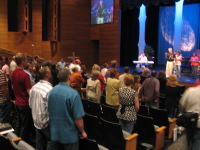
Last week I was in Phoenix for the annual Western Area Regional Ministerium, a gathering of Church of God ministers from across the western United States and Canada. This is the last surviving geography-based ministers' fellowship - at one time there were a number. Attendance at WARM was down this year, indicative of the economy and that this is an "off" year, away from the typical locus of Portland.

While I enjoyed the fellowship and the events (particularly the presentations of Milfred Minatrea), this was another occasion for me to reflect on the nature of gatherings in the Church of God. As many have pointed out, we are a movement that has historically found its identity and vitality in the relational connectedness found in gatherings. The reality, however, is that our social dynamic has changed, and to the dismay of those who cut their teeth on them, the role and popularity of events such as campmeetings and ministers' fellowships is diminishing quickly. The long decline of the North American Convention is a perfect example of this phenomenon.

There is much to affirm about our relational ethos, and we should be concerned about the growing disconnectedness that is emerging. But, it may be time for us to acknowledge the need for new wineskins to draw together the diverse cultures of our movement, let alone the even larger Body of Christ. This should also be an occasion for us to consider what really does unite us in Christ - is it our common social bonds, or should it be around the common mission to which we are called?

These are issues we must address as we define ourselves in these shifting times.


Tuesday, April 21, 2009

Geographic diversity

A recent Gallup Poll caught my attention as it correlates well with what I've been noticing in the Church of God: There are considerable differences across various regions of the United States. This is not only true in a general, religious sense, as with this poll, but the result is also reflected in how churches respond to their culture within those regions. Where religion is central to life the church tends to operate with ideological and theological security. Where religion is at the periphery the church cannot assume its place in society and must engage the culture in order to thrive, let alone survive.

As someone who has always lived on the geographic fringes of the continent and the Church of God I can easily see this phenomenon, and frequently see the glazed eyes of those in other parts of the country who cannot imagine anything other than the relative success that the church enjoys there and the methods that are employed.

(CLICK HERE TO SEE LARGER IMAGE)

While not perfect (i.e. factor out the Dakotas and Utah, for example) this map also somewhat reflects prevailing strength and attitudes in certain regions among Church of God people and congregations.

The reality is that despite our common heritage there is considerable diversity across our movement. And, that's not bad. If anything it reflects the magnitude and scope of the Kingdom of God and that despite our differences we are united in Christ.

What does concern me is that we are not always willing to recognize these differences, or create structures or programs to take them into account.

What do you think?


Wednesday, April 15, 2009

Church of God goes YouTube

One of the many things that caught my attention during my recent blogging drought was the announcement that Christians Broadcasting Hope (CBH), our mass media arm, has begun producing videos on YouTube, the web's leading repository of videos. It can be accessed through their user page at: www.youtube.com/user/CBH4hope.

My first reaction to this news was one of skepticism. How can the Church of God expect to gain a voice in the clutter and wasteland of YouTube?

While the initial offering of videos online is hardly impressive, what does impress me is the fact that we are at least exploring new media to get out out message. CBH has, for years, been one of the most innovative divisions of Church of God Ministries, and this further confirms their willingness to harness communication technologies for the sake of the Kingdom.


Tuesday, March 31, 2009

Dialogue in the Church of God

Those of you who subscribe to my blog may be surprised to see a post actually appear!

Without making any excuses, life has been extremely busy over the past few months. Blogging has taken a back seat to other priorities in my life and ministry. Not that I haven't had anything to write, just not the time to formulate them on the computer.

There are a number of important issues and matters confronting the Church of God at this time and I want this blog to be one voice encouraging constructive dialogue. Certainly, my blog is far from being that "important", but it is part of a new medium that can stimulate discussion and invigorate our relationships.

Yet, despite the challenges facing us, I am more and more convinced that we struggle with dialogue. We are a very diverse group of people and increasingly do always not share uniform convictions and perspectives. This is making it difficult for us to resolve some of our current challenges, and threatens to fracture us, even when one of our core beliefs is centered on unity.

More so than ever we need to be intentional about our interactions and discussions. Face-to-face communication is still the best, but we also need to find ways to hear each other across geographic, demographic, and even theological divides. Electronic communications such as blogs, Facebook and online groups (such as ChoGtalk) are new tools that can contribute to this dialogue.

I am personally committed to continuing this blog for this purpose, and look forward to sharing some thoughts that have been developing and accumulating in recent months. Also, for shorter bursts of inspiration and insanity I invite you to follow my ChogBlog Twitter feed.

May the dialogue continue!

Tuesday, January 20, 2009

Challenges and changes

The hard drive on my laptop crashed while in San Diego at the Area Administrators' meeting, preventing me from sharing about an extremely valuable conversation that we had with General Director Ron Duncan regarding the challenges confronting the Church of God. And these are much more than merely financial. They touch the core of who we are and how we relate to each other. Again I am impressed with Dr. Duncan's willingness to listen and openness to explore perspectives that challenge our status quo. Our discussions with him are just the beginning of many more that he is planning to have across the church in various settings and with a broad spectrum of people.

One of the opportunities just announced is a special town-hall meeting on "The State of the Church" hosted by Dr. Duncan and General Assembly chair Bob Moss at this summer's North American Convention. This event will be held on Monday, June 29 at 3:30pm at Reardon Auditorium.

Talking about the NAC, also announced are some significant venue changes for the services. Because of the high cost of equipping the Kardatzke Wellness Center in an environment of financial crisis two local churches will host the services instead. The evening services will be held at the relatively new Madison Park Church of God with shuttle service provided. The morning services will be held at Park Place Church of God.

These NAC changes are significant beyond just a building change. They also reflect the continued devolution of this event and its significance in the light of our movement. I really wonder if the NAC as it is can really survive. More so than ever we must be willing to explore new models for connection and drawing our people together.

These are interesting times. And we must be prepared to pray, dialogue and work for God's purposes.

Thursday, January 15, 2009

Structure

This week I am at the annual Church of God Area Administrator's meeting, in San Diego. This is a tremendous opportunity for district leaders to gather together for collaborative exchange, learning and fellowship. One of the features of our event is spending a day with a noted, outside resource person. This year John Kaiser, author of Winning on Purpose: How to Organize Congregations to Succeed in their Mission, was our guest. Kaiser is one of the leading experts today on congregational structure.

The whole matter of structure is an peculiar one for the Church of God. As I've highlighted before, our relationship to organizational structure came about more by necessity than by design. The result has been structures that are often ineffective, and even dysfunctional. This can be observed at all levels: national, regional and congregational. Fortunately, we are beginning to recognize the need for change; although our uneasy history with organization makes it difficult.

I encourage you to read Kaiser's book. There are many practical applications that are very relevant to the Church of God and our polity.

Monday, December 22, 2008

Relfections on financial challenges

The announcements of layoffs and budget cutbacks at Church of God Ministries have generated considerable concern in recent discussions in which I have been involved. The news is somewhat unsettling, although not everyone is panicked. Some see this merely as a necessary adjustment that organizations need to regularly go through as they rationalize their activities, especially in a time of economic downturn. I am not convinced it is that simple.

These financial challenges, as Dr. Duncan pointed out in his recent letter, have been developing for quite some time and are reflective of much more profound challenges facing us.

First, I believe this is indicative of the bigger struggle that we continue to have over becoming a "denomination", even though we tend to deny that this remains an issue. C. E. Brown's suggestion that there is a difference between "organizing the church and organizing the work of the church" is true, but we nevertheless remain uncomfortable with intentional structure and organization, even to the point of this attitude being detrimental at times. The debates earlier this year over our hyper-congregationalism illustrates this. Sadly, however, we tend to divide on this issue at the extremes, and fail to see more reasonable solutions that both respect the dynamic nature of the church, and insure cooperation and accountability. The result of all this internal tension is a relatively low level of commitment to national and, in some cases, district organizations.

Second, these struggles with centralized organization are not just limited to the Church of God. There are also some broader trends at play here. The wisdom of centralization is increasingly questioned and dismantled across many sectors of our society, including government, business and religion. Our information age has spawned a new approach for cooperation: non-hierarchical networks. For example, at one time it made perfect sense for centralized, denominational missions organizations as missions endeavors were very complex and costly for individual congregations. But now, churches want to get personally involved in missions, even sending their own missionaries and establishing direct contact with churches and ministries in other lands through regular communication, direct giving, and missions trips. Merely sending money to a national mission organization does not have the appeal it once did. The lesson in all of this could be that an organization like Church of God Ministries may have a greater role in facilitating networks than actually delivering services. As simple as this sounds, it would be a radical change.

Third, the challenges we face can also be attributed to the lack of a coherent, consistent, and compelling vision for our movement. This is not any one particular person's fault (or responsibility), although it does reflect our current lack of and distrust of strong leaders. All of this reflects a steady erosion of purpose since our founding almost 130 years ago. Our movement was based on some very clear ideals, and was later reinforced by a church-historical eschatology. Since that time we have become much more geographically and sociologically diverse; our theological positions have been refined; there has been a great urge to identify with mainstream Evangelicalism; and there are other voices and groups effectively proclaiming aspects of our message. Certainly attempts have been made to cast a new vision for the movement, but none have captured widespread enthusiasm or acceptance.

In light of these reflections I believe that this is a critical time for Church of God Ministries to continue the process of reinventing itself. Or even better, for our movement to define itself and then reinvent Church of God Ministries to serve that purpose. Obviously this is a grand challenge, and not one that can happen in a short amount of time. But, it needs to happen, and we must be committed to it now.

Wednesday, December 10, 2008

More budget woes

Continuing on the recent layoff announcements at Church of God Ministries, General Director Ronald Duncan recently sent pastors an email with a more detailed financial update and a revised budget for 2009 set 25% lower.

Certainly the financial stresses in Anderson are real. From communications I've had with people at our national offices, the last few weeks have been difficult. In keeping with the broader financial challenges experienced across the country right now, there is considerable anxiety as to whether the near future will bring any more bad news. Duncan revealed some of this concern with comments like:

"The manner in which we collectively view these reductions will affect the future of our movement. Some may view these reductions as failure. I certainly have reflected on this point of view. There is an element of these reductions that certainly feels like failure—failure of our congregational system of polity to support and fund the decisions of the General Assembly, failure of Church of God Ministries to adequately challenge and provide the necessary motivation to inspire support for the budget, failure of our leaders and congregations to deal with the gravity of the situation, and failure on my part to provide the leadership necessary for success. ...

"Throughout the Church of God’s 127 years, finding the financial support for the congregational, state, and national ministries has been a constant challenge. We seem to be dealing with an old, yet unresolved, question: Are we living and teaching principles of stewardship from the New Testament? Our future in both the near-term (one to two years) and our mid-term (three to five years) will be affected by how we respond." [emphases his]


I will offer some of my own thoughts on the future in an upcoming post, but for now let me say that I agree with Duncan that this is a critical moment in the history of our movement, at least from an organizational perspective. The current financial realities and trends indicate that there is not a common consensus across North America as to what our cooperative ministry should look like within our polity, in light of our doctrinal convictions, and in response to the challenges of ministry today.

Ultimately this will be resolved. Either by necessity or design. Hopefully, it will be the latter.


Monday, November 24, 2008

Church of God Ministries reduces staff by 25%

General Ronald Duncan sent out a notice today that in order to cut expenses Church of God Ministries is reducing its workforce by approximately 25%. This is in response to the continued decline of giving to the basic World Ministries Budget.

Obviously these are tough financial times in our world, a fact that makes these cuts prudent. The decline in giving, however, began well before the current global crisis.

There will be many opportunities to sort through all of this, including analysis of why, and how we should respond for the future. For now, however, prayer for the families affected by these layoffs should be our priority.

I noticed that this information is not yet available on the Church of Ministries website, so I will include the text of his email for those of you who did not receive it.

Dear Fellow Servants of the Church,
 
It is with a heavy heart that I share with you that Church of God Ministries has found it necessary to
release eight current employees in an effort to reduce our overall expenses to within our projected income. The elimination of their employment, combined with seven other full-time and four part-time positions that have been vacated over the last few months that we have chosen not to fill, represents a reduction in our workforce of approximately 25 percent. This is one of the numerous steps we are taking to ensure compliance with the Ministries Council’s Ends Policy that specifies Church of God Ministries submit a balanced budget with no deficit.

It was especially difficult to let these valued and high quality employees go who have dedicated their work to the service of the church.  Those losing their jobs included a team director, three ministry administrators, a graphic designer, an educational administrator, a church and donor relations consultant, and a part-time ministry assistant. To help them through this difficult time we are offering them a separation package. The terminations are effective November 28, 2008. Please pray for these individuals who have lost their jobs.

During the 2008 General Assembly, I proposed a baseline budget process to better align our budget with actual income. This resulted in a 10 percent reduction of the Basic portion of the 2008 World Ministries Budget. This baseline process guides our efforts towards the development of the 2009 and 2010 budgets. Regrettably, giving to the Basic Budget has continued to decline.
 
A detailed financial analysis this month of our income streams, expectations, and anticipated expenditures has led us to a difficult place. Our Leadership and Management Teams have worked diligently to cut expenses, find efficiencies, and increase revenue. In early December, I will share with you the 2009 and 2010 budgets and enumerate the additional reductions related to ministries (either reduced or deleted) we find necessary to realign our budget.
 
Our vision and mission remain the same-to transform culture by being the body of Christ. Please continue to pray for the church and our efforts here at Church of God Ministries as we coordinate the collective ministry of the Church of God at the national level. The Lord is good and greatly to be praised-even in these difficult times.
 
Grace and peace,
 
Ronald V. Duncan
General Director


New conversations

It has been interesting to see the prolific growth of blogging within the Church of God. On my blogroll are listed as many as I am aware of, but I'm sure there are many others as well. Blogging is certainly representative of a new, decentralized media that permits a wide range of voices to contribute to important (and even unimportant) discussions.

But, blogging is only one example of the new conversations that are occurring across our movement. The latest involves Internet social networking, best represented currently through Facebook. New webs of communication are facilitated here. An example of the power of social networking conversations can be seen in a brief post that one of my "friends" started last week on Facebook. The topic was entitled "Church of God (Anderson) If we're so right...?" Within 8 hours over 32 responses had been shared, created a relatively vigorous discussion.

With whom are you talking?

Thursday, November 06, 2008

Coaches event

Over the past few days I was in Phoenix for the second-ever Coaches event, designed specifically for coaches involved in either SHAPE or CTI (Coaches Training Initiative). Church of God Ministries has invested heavily in this event (along with Lily Endowment funds), believing that these are probably some of the most significant transformation agents for congregations and pastors. Approximately 100 were in attendance this year.

What has made these events so significant are the high caliber of resource people brought in and the timely topics addressed. This year was no exception. For example, David Ferguson (a return guest from last year) led us through a insightful examination of relational leadership. Gary Kinnaman spoke in our evening gatherings, challenging us to adopt beliefs, attitudes and practices that will contribute to bringing about healthy, lasting leadership. Our last morning together featured a presentation on holiness led by Jeannette Flynn (more on this in a future post).

A common theme that permeated the three days concerned the priority on relationships in ministry, certainly a message that is relevant for this time and the Church of God.

Monday, November 03, 2008

Update

Over the past month this blog has been considerably quiet. There just hasn't been much time for blogging.

In addition to taking some vacation time with my wife, there has been much activity within the district I serve. Our annual meeting was held on October 4th, at which time there was overwhelming support for a new structural change and bylaws that will transform our organization and ministry. This will have considerable impact on my workload as we transition in this new direction. The next year will be particularly demanding, but nevertheless exciting.

Today I am traveling to Phoenix for the second Church of God Coaches Event. As I reported last year, this was a milestone event in our history and reflects part of the cultural change among our leadership. Later this week I will post my reflections on this year's version.

Thursday, October 02, 2008

Emerging leaders

Those of you subscribing to blogs will be interested in tracking The Sirius Network, a new "expanding group of people within the Church of God and beyond who are committed to creating a culture that nurtures young and emerging leaders". This is the result of work headed by Suzanne Haley of the Leadership Development Team within Church of God Ministries. They are wanting to connect emerging leaders in the Church of God and are tapping into contacts already made through our colleges and at the International Youth Convention. Besides the blog they also have Facebook and MySpace pages to foster the growing use of social media especially by younger generations.


Friday, September 26, 2008

Church planting revolution

The past few days I have been at Indian Creek Community Church in Olathe, Kansas (just outside of Kansas City) at the annual conference of Church Multiplication Association (CMA) for church planters. This has been one of the most significant Church of God events that I have been to in a long time.

For those of you that don't know, CMA is a Church of God - related organization that is leading the way in our movement for church planting. They have helped plant over 60 churches and have experienced tremendous success compared to most typical church planting efforts. Founded by Robin Wood and Gary Kendall, CMA provides a high level of screening, training, and support for church planters.

There are several reasons I consider this event as significant. First, it represents an exciting, new thrust in church planting. Sadly, in recent decades church planting has been hit and miss within the Church of God. While some tremendous new churches were launched, overall it is a small number and we have lacked a coherent vision or methodology.

Second, attending this event put me in contact with some of the most gifted and passionate young ministers in our movement. Seeing the quality of this group gives me great hope for the future!

Third, CMA represents a new paradigm in how we get things done within the Church of God. Despite our struggle with becoming a "denomination" the bulk of our cooperative efforts have been in centralized structures. CMA was not conceived in "Anderson". It is a network that operates within the Church of God, but not within our formal structures. This may go against what we are used to, but is indicative of a trend that is developing around us, and may be more congruent with our polity. Networks have tremendous effectiveness, and probably will represent the future in many other areas of our national life, such as missions. I was impressed to see that Church of God Ministries is not feeling threatened by the growing prominence of CMA, but instead is embracing this work and cooperating with it. The evidence of that is found in the fact that Dr. Duncan brought the Ministries Council to Olathe this week for their meeting, and so that they could experience first-hand what is happening in this "movement within a movement".

Finally, the event itself provided significant opportunities for personal growth and ministry development. CMA brought in some outstanding speakers and practitioners, and offered a wide range of helpful conferences and presentations. The evening worship services themselves were worth the trip. For example, on Tuesday evening I witnessed one of the most profound moments of honesty, transparency and grace confronting personal brokenness among leaders that I have seen in the Church of God.

If you are desiring to experience new vision and hope for the Church of God, I'd encourage you to learn more about CMA and to plan on attending next year's annual conference.

Tuesday, September 09, 2008

Women in Ministry article

Following up on the recent, lively discussion that resulted from my "Women in Ministry" post, I came across a sermon by Dr. David Sebastian, Dean of the Anderson School of Theology. This brief writing provides a good overview of the some key issues and scriptural passages at the center of the current debate, and is now an included resource for the "Cultivate" Goal comprising the Church of God strategic plan. It is worth reading.

LINK (The document "Women and Men: Guarding Our Sacred Partnership in Ministry" can be found under "New Resources" near the bottom of the page).

Sunday, August 31, 2008

Hermeneutics

Those of you new to reading blogs may not really be aware that this is an interactive medium - you have an opportunity to interact with the author and other readers over each post. Reading the comments can be a great way to dig deeper into the topic and engage in a discussion. On this particular blog most of my posts receive a few comments, but my recent "Women in Ministry" post broke a new record for the number of responses. It obviously touched a nerve on this vital subject, and reveals its controversial nature and even the surprising diversity of opinion within the Church of God. If you haven't already done so, I encourage you to read the entire dialogue.

I limited my own responses, partly because some others took up the cause, but also because this is a subject that is really the result of some deeply held presuppositions regarding the nature of and interpretations of Scripture. Our understanding of whether or not women are called to pastoral ministry is based on what we believe is taught in the Bible. But the interpretation of these passages is obviously not that simple, based on the divergent views represented.

Biblical hermeneutics is an area that has caused considerable tension within our movement over our relatively short history. While we all agree on the authority of Scripture, how it fits into God's larger revelation and should be interpreted is not uniform, especially in recent decades. The influence of American Fundamentalism and Evangelicalism has impacted our perspectives and approaches to the point that our original holiness orientation to Scripture is largely over-shadowed.

The Church of God emerged out of pietism and Wesleyanism, as well as the holiness movement of the late 19th century. The result was a theological orientation that did not fit well with the dominance of Calvinistic thinking around it, or with the later modernistic debates that have shaped American conservative thinking. Our pioneers had a high view of Scripture but it is clear from their writings and ministry that the Bible was never an authority detached from God's larger revelation. The truth of Scripture was always dependent on the illumination of the Holy Spirit. And, Biblical truth, to be of value, expressed itself in praxis, or as we framed it: holiness. Truth was not some objective enterprise that stood apart from God, including the living Word (Jesus Christ) and the work of the Holy Spirit. Modern rationalism, however, changed the intellectual landscape of Western Christianity, with both liberalism and fundamentalism products of its worldview. Human reason became the standard by which truth is discovered and measured. Sadly, the Church of God has been distracted by these influences and many have bought into the rationalistic arguments that lead to a wooden (and often inconsistent) literalism and the red-herring logic behind inerrancy.

Not only concerning the women in ministry issue, but with all that draws us together doctrintally, it is essential that we come to terms with our understanding of and approach to Scripture. We would be wise to learn from the dynamic hermeneutic of the early Church of God. This is not to unrealistically romanticize our heritage. Certainly, even our hermeneutic has evolved and will need to continue to do so. For example, we have been weak at understanding the Bible within its original historical context, which is evident by the misguided apocalyptic ecclesiology that dominated our theology in our first half-century and still lives on in some sectors today.

Going back to the recent debate, I remain convinced that the calling of women to ministry leadership is consistent with the Gospel of Jesus and the practice of the New Testament church. For those of you that differ with this view, let's acknowledge and explore our hermenutic approaches. It's the real discussion we need in the Church of God.

Wednesday, August 20, 2008

Women in Ministry

An article in Ohio.com (Akron Beacon Journal) brought to light again the challenge we are having in the Church of God validating the ministry and leadership of women.

The good news is that Arlington Church of God, one of our prominent congregations, announced that Diana Swoope has been chosen to succeed Ron Fowler when he retires in the coming months. Beyond her local church, Swoope is well-known across the Church of God because of her national involvements and powerful preaching.

The newspaper article addresses the fact that women are having a harder time finding a church to pastor in the Church of God. Just over 10% of our senior pastors are women, a figure even more troubling considering the fact that at the beginning of our movement women had a much larger role. Unfortunately, again we've been influenced by the larger church culture around us, even when it conflicts with what we understand Scripture to teach. Sadly, many of our congregations resist the idea of having a female pastor, and even some of our current ordained ministers do not believe women should be in this role.

I celebrate the affirmation of Diana Swoope in Akron, Ohio, and hope that this will lead to more women called to career ministry finding their place in our congregations.

Monday, August 11, 2008

Review: Faith in the Future

For a slight change of pace I want to briefly comment on one of the new books published by Warner Press this year. Our publishing house releases several books every year, usually in conjunction with the North American Convention. Increasingly they are securing titles that can be marketed outside of our movement, and to the church at large.

While I do not have time to read or review every new Warner Press book, the one that caught my attention this year is Faith in the Future: Christianity's Interface with Globalization by Church of God missionary Patrick Nachtigall. I decided to purchase this because it covers a compelling topic that I don't hear discussed much in our circles.

Nachtigall's purpose in the book is to "look at some of the new things that are currently happening in our world so that Christians can be better informed and more prepared to engage the world with the gospel" (p. 2). As someone who has first-hand experience of living in different countries and cultures, Nachtigall brings his own personal experience and insight to the topic. He addresses a wide range of issues, including peace, poverty, sexual slavery and the environment. Some he sees as opportunities, others as challenges.

The value of this book will be in its application as a discussion starter, especially for mission-minded individuals and church groups. While I can't say that I learned much that I hadn't heard before, his drawing together of these issues provides for a great introduction, especially for the many Americans who seem to be somewhat insulated from the global trends happening around them.

Again, this book shines as an introduction and thought-starter. I was somewhat disappointed in that, for me, Nachtigall doesn't engage these issues enough with the gospel message and the implications for the church. He certainly touches on these components, but I expected more. Some may also be somewhat surprised and skeptical at his apparent over-optimism for some of the global trends that he writes about.

This is one of those books that is being marketed outside of the Church of God, and it is impressive to see the sharp design and layout of the book. This makes the book more attractive to those who tend to "judge a book by its cover". But, hopefully it will give Warner Press a bigger position within Christian bookstores, with the prospect that our voice will be heard more and wider in the future.

Tuesday, July 29, 2008

Addressing the Budget

Last week Church of God pastors were sent an email in regards to a special video message from General Director Ron Duncan concerning the current status of Church of God Ministries' budget. As we learned at the General Assembly, giving is down significantly and has been on a downward trend for several years.

Duncan's message is designed to communicate this message far and wide across the Church of God in North America. The facts and his plea need to be heard.

I think it is far too easy to look for simplistic explanations as to why this budget problem exists. Some might want to blame the economy or going disconnectedness with "Anderson", but I believe there are two reasons that especially stand out:

1. Undesignated giving is losing its value. This has been a trend developing for several decades now, and it not only affects giving to our national and regional bodies, but to local churches as well. Older generations gave out of sense of duty and obligation, whereas increasingly people today are giving where they see specific needs (e.g. missions projects, etc.). Obviously stewardship principles need to be reinforced, but this is a reality that is severely limiting the church's ministry at all levels.

2. Lack of clarity on the purpose of our national organization. While greater efforts have been made to express a vision for the Church of God in North America, it still has not filtered down to the local congregations where decisions are made whether to support Church of God Ministries. With many churches stuggling to meet their own local budgets, it is easy to see how cutting or eliminating support to "Anderson" is determined.

In resolving this we must get past our regrets, and pronouncements of "oughts" and "shoulds". The starting point must be facing the realities of the current situation, and from there we must inspire with a cooperative vision for our movement going forward. Otherwise, our budget problems will persist.

Monday, June 30, 2008

Get Up and March

In response to my request, Curtis Ferrell has given me permission to post the lyrics from the song he wrote, and sang Wednesday evening during NAC. Be sure also to watch and listen to it online.

Get Up And March!
Ferrell, Curtis L.

Verse 1:
This world doesn't need another satellite, spinnin' round,
Beamin' God's love to the ground.
This world doesn't need another TV preacher
Makin' all the saints fall down.
This world doesn't need another pretty Christian song
Playin' loud on the radio band.
What this world needs is for the church of God
To rise up and take a stand.

Chorus 1:
I'm talkin' 'bout love, I'm talkin' 'bout faith.
I'm talkin' 'bout mercy, I'm talkin' 'bout grace.
I'm talkin' 'bout healing, I'm talkin' 'bout peace.
I'm talkin' 'bout freedom, I'm talkin' 'bout sweet release.
Get up and march!

Verse 2:
This world doesn't need another superstar sayin' that
God helped him win the game.
This world doesn't need another Christian politician
Beggin' votes, power, money, and fame.
This world doesn't need another half a dozen cruise ships
Crusin' to the Holy Land.
What this world needs is for the church of God
To rise up and take a stand.


Chorus 2:
And live out love, living out faith.
Living out mercy, living out grace.
Living out healing, living out peace.
Living out freedom, living out sweet release.
Get up and march!

Verse 3:
Rise up, O church of God!
Have done with lesser things.
Give heart, and mind, and soul, and strength
To serve our King of Kings!
Rise up, O men of God!
The church for you doth wait
Her strength unequal to her task
Rise up, and make her great!
Get up and march!

Verse 4:
Like a mighty army
Moves the church of God;
Brothers, we are treading
Where the saints have trod:
We are not divided
All one body we,
One in hope and doctrine
One in charity.
Get up and march!

Verse 5:
Then forward let us go
Our hearts with love aflame
Our snowy banner borne aloft
Inscribed with Jesus name
The hosts of evil flee
And heaven's open gates
Invite us now to hasten
Where Eternal glory waits.
Get up and march!

Verse 6:
Must Jesus bear the cross alone,
And all the world go free?
No, there's a cross for everyone,
And there's a cross for you and me.

Bridge:
How will they believe If they have never heard?

Ending:
How will they believe If they have never heard?
How will they believe

© 2001 Curtis L. Ferrell, 805 Crescent Drive, New Castle, IN 47362 (ASCAP)